





{{current_weather.dt | moment( atts.date )}}
{{current_weather.temp | temp}} °{{units}}
{{day.dt | moment(atts.date)}}
{{day.temp | temp}} °{{day.temp_min | temp}} °{{units}}
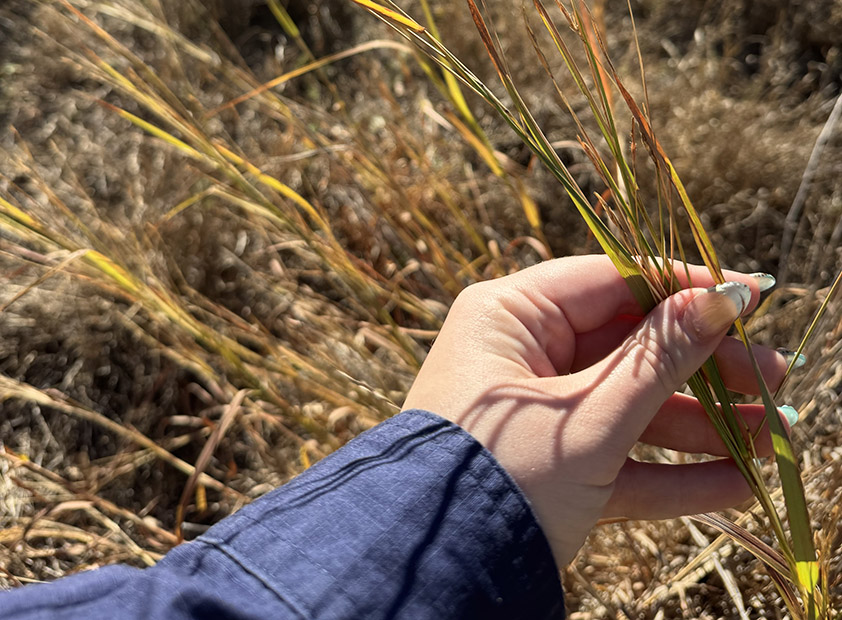
They might not be the most spectacular plants on the landscape, but native grasses are some of the quiet achievers of mine rehabilitation.
Around Oaky Creek Coal (OCC) and the wider Central Queensland terrain, native grasses are an important part of the landscape; and when it comes to choosing grass for rehabilitation purposes, OCC’s Environment & Community Department pays particular attention to the three Ps: Perennial, Palatable and Productive.
Perennial grasses live for several years rather than completing their lifecycle in a single season. Their established root systems (that grow in clumps called tussocks) help hold soil together, improve the overall structure of the soil, and allow plants to survive through changing seasonal conditions.
Palatable means the grass provides nutritious (and tasty) food for grazing animals, like cows, sheep, and goats, as well as native animals like kangaroos. This is particularly relevant when mining rehabilitation is intended to support a future grazing land use.
Productive grasses produce enough plant material to contribute meaningful groundcover that prevents erosion and provides food for livestock to support a functioning grassland ecosystem.
“Together, these characteristics make 3P grasses particularly useful indicators of how a rehabilitated landscape is developing,” explains Madison Bennett, Environment and Community Advisor at OCC, specialising in Biodiversity & Assurance.
Forest Bluegrass (Bothriochloa bladhii) is a native perennial pasture grass found across Queensland. It’s palatable to cattle when young and actively growing, and its perennial growth habit helps provide persistent groundcover.
“Its ability to survive dry periods and respond when conditions improve makes it a useful part of resilient grazing and rehabilitation landscapes,” describes Madison.
Kangaroo Grass (Themeda triandra) is one of Australia’s most recognisable native grasses, with its distinctive reddish-brown seed heads that become particularly noticeable as they mature.
“Kangaroo Grass is built for resilience. As a long-lived perennial, it stores much of its energy below ground in its extensive root system, allowing it to regrow after periods of drought, grazing and even fire. That staying power makes it a great addition to a resilient rehabilitation landscape.”
Black Speargrass (Heteropogon contortus) is a hardy native perennial named for its distinctive dark, twisted spear-like seeds. These seeds can work their way into a sheep’s wool and irritate their skin. Fortunately, that’s less of a concern for cattle, making speargrass much more welcome on a future cattle-grazing landscape.
Successful rehabilitation isn’t simply about making disturbed land look green. The types of grasses present can be just as important as how much grass there is.
“A rehabilitation area dominated by short-lived or undesirable species tells us something very different from an area supporting a diverse community of established native perennial grasses.
That’s why rehabilitation monitoring at Oaky Creek Coal looks at 3P grass presence to understand not just how much vegetation has been established, but what that vegetation community is actually made of.”
So, while they may not have the star power of a flowering native tree or a passing mob of kangaroos, our humble native 3P grasses are definitely punching above their weight class when it comes to rehabilitation.
Fun Fact: ~12,500 hectares (two thirds of OCC’s total lease area) has been earmarked as grazing land once the mine ceases operations. In fact, some areas of previously mined land that have been successfully rehabilitated are already being used for grazing. Yes, OCC is also an active cattle property!

Tieri considers the health and wellbeing of the community a priority. Due to the ongoing Coronavirus (COVID-19) pandemic we have created the Tieri Covid-19 Hub. Please subscribe if you would like to receive a notification when important information is updated on this site.