




{{current_weather.dt | moment( atts.date )}}
{{current_weather.temp | temp}} °{{units}}
{{day.dt | moment(atts.date)}}
{{day.temp | temp}} °{{day.temp_min | temp}} °{{units}}
Who is the maintenance team made up of?
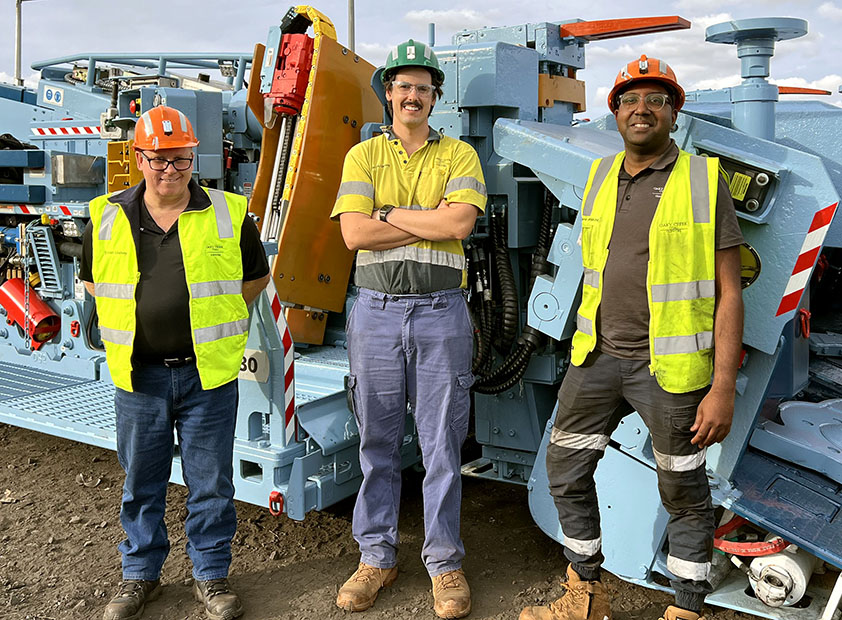
A diverse group of people including trades, technicians, operators and engineers. The team includes myself as Maintenance Superintendent, Dan McCamley as Reliability Engineer, Mark Murray and Leander Chihuri as our Condition Monitoring Technicians, Jamie Fleming as Maintenance Engineer, and Mel Munro, Brad Cannon, Brad Hardgrave, Terrence Macheru, and Brendan Lindsey as Maintenance Planners.
What are you responsible for at OCC?
I lead the Reliability and Planning Function, which includes:
• overseeing maintenance planning
• reliability engineering
• condition monitoring activities
…all of which help support the safe, reliable, and efficient operation of our assets across the business.
The role is focused on improving work management practices, planning quality, equipment reliability, defect elimination through root cause analysis, and long-term asset performance, while working closely with production teams to support day-to-day operations.
A big part of the role is also about building collaboration across the business and helping create a more proactive approach to maintenance and reliability.
Can you tell us any of the projects or workstreams you’re currently focused on?
• Strengthening our maintenance work management processes and improving how we plan, schedule, and execute work across the operation. A lot of effort is going into building more consistent and sustainable processes that improve planning quality, schedule compliance, and overall maintenance efficiency.
• Improving equipment reliability through defect elimination initiatives, condition monitoring, and better use of operational and maintenance data to support decision-making.
• Increasing visibility and engagement with crews underground and in the field, ensuring our team remains closely connected to the operation and the challenges people are facing day to day.
• Continuing to refine maintenance strategies, with a big focus on optimising our trunk belt strategies and ensuring our maintenance on electrical assets is asset specific and ensuring compliance to legislation and Australian Standards.
What are some of the biggest challenges your team helps solve?
We help to maintain safe and reliable equipment, while balancing operational demands. In mining, production requirements can change quickly, so a large part of our role is ensuring maintenance work is properly planned and prioritised to minimise downtime while still managing risk appropriately.
The team also plays a key role in identifying and addressing recurring equipment reliability issues. That can involve analysing failures, improving maintenance strategies, coordinating defect elimination work, and working closely with operations and execution teams to prevent problems from becoming larger operational impacts.
Ultimately, a lot of what we do is focused on creating a more proactive operation, reducing reactive work, improving planning quality, and helping the business make better long-term decisions around asset reliability and maintenance.
What experience or skills are most important in your line of work?
One of the most important things in reliability and maintenance planning is understanding both the equipment and the people involved in keeping an operation running. Technical knowledge is critical, but so is the ability to work closely with different teams, coordinate priorities, and make practical decisions in fast-paced operational environments.
I was fortunate to start my career in the coal mining industry more than 15 years ago with Joy Mining, where I gained hands-on exposure to Longwall and Development equipment. That experience gave me a strong understanding of how these assets operate, how they fail, and what is required to maintain them safely and effectively. It also gave me a real appreciation for the importance of product knowledge and the value of learning directly from the people working on the equipment every day.
Over time, I’ve learned that success in this field is built on a combination of problem solving, communication, planning, and the ability to interpret operational and maintenance data to make informed decisions. Working closely with operations and execution teams is a huge part of the role, because reliability is never achieved by one department alone; it comes from collaboration across the business.
In mining especially, where safety and production are so closely linked, having a strong understanding of risk, asset management, and continuous improvement is essential. It’s an industry that constantly challenges you to keep learning and adapting, which is one of the things I enjoy most about it.
Why is your team’s work important to the ongoing success of OCC?
Reliable equipment and effective maintenance practices are critical to keeping the operation running safely and efficiently. Our role is to help ensure maintenance work is properly planned, risks are managed, equipment reliability is improved, and the workforce has the support and information needed to execute work safely and effectively.
What impact does the work of your team have on the wider team, customers, stakeholders, or the community?
It has a direct impact across the entire operation because effective maintenance planning and reliable equipment are essential to supporting safe and consistent production.
By taking a more proactive approach to reliability and maintenance, the team helps reduce unplanned downtime, improve safety outcomes, and support more stable operations.
What’s something people might not realise your team does behind the scenes?
How much work goes into maintaining and improving our maintenance documentation, particularly updating Production Resource Tools (PRTs) and related maintenance documents. Historically, this has been a long-standing challenge for the business, so a major focus for the team has been improving the quality, accuracy, and consistency of these documents.
One of the key things we are encouraging is for the workforce to actively markup documents in the field and bring any issues, improvements, or inaccuracies directly back to the Maintenance Team for updating. The people using these documents every day often have the best insight into what works well, what needs clarification, and where improvements can be made.
By creating that direct feedback loop between the field and the planning and reliability teams, we can continuously improve the quality of our documentation and ensure it better reflects the realities of the job. Ultimately, better documentation helps improve safety, planning quality, work execution, and overall reliability across the operation.
What do you enjoy most about your job?
The variety and the opportunity to solve real operational problems that make a difference to the business. No two days are ever the same. One day you might be working through a reliability issue on critical equipment, and the next you’re helping improve a process or supporting teams to better plan and execute work.
I also enjoy working with people across the operation. Underground mining is a team environment, and some of the best outcomes come from bringing different groups together to solve problems collaboratively. Seeing improvements in reliability, planning quality, and overall team engagement is really rewarding because you know it has a direct impact on safety, production, and the day-to-day workload of the crews.
What are you excited about for this year?
Continuing to build and strengthen the Reliability and Planning Function across the operation. There’s a real opportunity to further improve how we plan, schedule, and execute maintenance work, while also increasing engagement between maintenance, operations, and engineering teams.
I’m also looking forward to seeing the benefits of some of the work management and reliability initiatives that have been put in place over the last couple of years. A big focus for the team is moving toward a more proactive maintenance culture, improving visibility underground, and continuing to build systems and processes that are repeatable, efficient, and sustainable long term.
Most importantly, I’m excited about continuing to develop the team and creating an environment where people feel supported, engaged, and empowered to contribute to improving the operation.
The whole team is stuck on a desert island, who is most likely to find their way home?
No one. True to form, the team would raise a work order and a Purchase Request for a boat to come and rescue us, but someone would forget to attach the snippet from the forecast sheet…in all seriousness, it would be Mel – she lives on a boat and is very well travelled. She would likely be the only survivor!
If a movie was being made about the maintenance team, what would be the title of the film?
“When the Belts Stop”.
What motto does the team work by?
People, Processes, and Assets.
We believe strong maintenance and reliability outcomes start with people building capable teams, maintaining strong communication, and working collaboratively across the operation. From there, having clear and consistent processes is critical to ensure work is planned, prioritised, and executed safely and efficiently.
When you get the people and processes right, the assets will generally perform the way they are intended to.
It’s a simple mindset, but it keeps the team focused on supporting each other, improving the way we work, and ultimately delivering safer and more reliable operations.
If there’s one thing you’d like the organisation to better understand about your team, what would it be?
The team is focused on creating a more proactive and reliable operation, and that requires close collaboration with every part of the business. The best outcomes are achieved when maintenance, operations, engineering, and support teams are all working toward the same goals. At the end of the day, we’re here to support the people doing the work in the field and help ensure our assets are safe, reliable, and available when the operation needs them.
How can people engage with the maintenance team?
We’re always out and about, so the best way to engage with us is simply to have a conversation when you see us, or drop into the Engineering Office and Production Office opposite the Conveyor Team.
You will also start to see us more underground. One of our key focuses is being more proactive and engaged with the operation where the work is happening, rather than just working from behind a desk. Building strong relationships and maintaining open communication with the wider workforce is a big part of improving reliability and supporting safe, efficient operations.
Tieri considers the health and wellbeing of the community a priority. Due to the ongoing Coronavirus (COVID-19) pandemic we have created the Tieri Covid-19 Hub. Please subscribe if you would like to receive a notification when important information is updated on this site.