





{{current_weather.dt | moment( atts.date )}}
{{current_weather.temp | temp}} °{{units}}
{{day.dt | moment(atts.date)}}
{{day.temp | temp}} °{{day.temp_min | temp}} °{{units}}
Coal doesn’t just appear at the surface ready to be mined – finding and extracting it is an involved process. In Australia – and at OCC – coal mining is both at the surface (open-cut mining) and deep underground (underground mining). In fact, about 80% of Australia’s coal production comes from open-cut mines, which target coal seams near close to the surface. But with underground mining a bit more of a mystery to most people not directly working in the industry, that’s what we’ll be looking at in this series.
The first step in the coal lifecycle is exploration. Finding the coal deposits with good mining potential is a high-tech endeavour that combines geology with advanced equipment. This includes:
Geological surveys – Geologists review existing geological maps, historical records of any coal finds, and conduct aerial and field surveys to identify locations that likely contain coal seams (locations that are found to have coal are known as coal deposits).
Exploration drilling – Drill rigs are used to make narrow holes deep into the ground to extract core samples so geologists can check for confirm the presence/extent, depth, thickness and quality of coal deposit. Exploration projects can contain dozens to thousands of holes drilled over many years. Once the cores are recovered, we check the samples to determine the type of coal, energy content, moisture, elemental composition and any impurities. This helps us determine how the coal could be used and if it’s economically viable to mine.
Geophysical methods – Geophysical surveys using techniques like 3D seismic surveys are utilised to further map potential coal seams and identify faults or other geological anomaly that could affect mining. The easiest way to think about this is like an underground ultrasound.
Mapping and analysis – All the data from maps, surveys and drilling are collated together to create 3D models of the coal deposit underground. This helps us estimate how much coal is there and if it’s economically feasible to mine. We also assess how deep the coal is, its quality, and if there are any environmental or land use constraints.
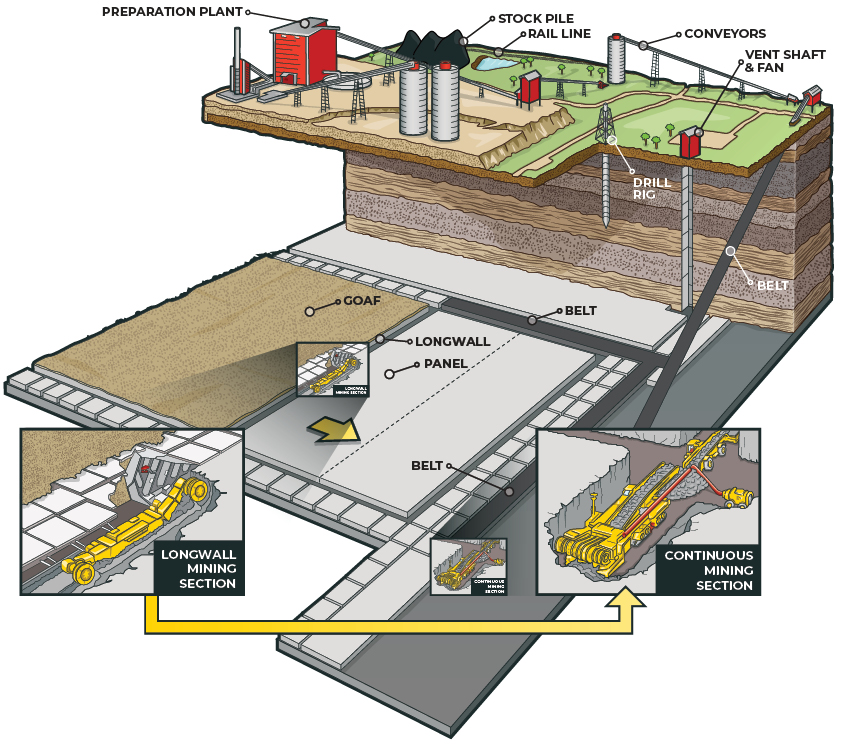
We’ve confirmed there’s a coal deposit, and worked out it’s economically viable to mine. Now it’s time to get the coal out of the ground. For coal that’s deep or where the surface land can’t be mined, underground mining is the method of choice. There are two main methods of underground mining used in Australia: bord-and-pillar mining and longwall mining:
Bord-and-pillar mining (also called room-and-pillar mining): Miners develop roadways (similar to tunnels) through the coal seam in a grid-like pattern, leaving behind pillars of coal to support the roof. The word “bord” is an old mining term for an open chamber or tunnel, and “pillar” is literally means the chunk of coal left behind to hold the roof up. Typically, a continuous miner is used, which has a rotating drum with picks that cuts the coal and feeds it onto a conveyor.
Longwall mining: In a longwall mine, the coal seam is divided into large blocks or “panels,” typically 1.2 to 4.3 kilometres long (but can be as long as 8km) and a few hundred metres wide (typically can range from 250m to 420m). It’s a highly mechanised method that can produce large volumes of coal in an efficient and cost-effective manner – often several thousand tonnes of coal per shift, with capacity to operate 24/7 with automated systems. The key machinery is the longwall shearer – a large mechanical cutting machine that moves back and forth across the entire coal face, slicing thick layers of coal which then falls onto a coal clearance conveyor, called a pan line. Longwall is considered a “high extraction” method and can deliver a lot of coal with a lower labour cost per tonne.
It takes a diverse team of skilled people to explore for and mine coal. Here are some of the typical jobs in these stages:
• Exploration geologist
• Drillers and drilling offsiders
• Surveyor
• Mining engineer
• Underground miner / machine operator
• Electrical and mechanical trades
• Ventilation officer
• Safety officer
• Shotfirers (if needed)
So, now you know how we go about deciding where to mine and how we get to the coal. Next issue we’ll take a look at how the coal gets processed.

Tieri considers the health and wellbeing of the community a priority. Due to the ongoing Coronavirus (COVID-19) pandemic we have created the Tieri Covid-19 Hub. Please subscribe if you would like to receive a notification when important information is updated on this site.